
FAQ’s
Prior to completing an Expression of Interest form, we recommend reading through these FAQ’s. Applications will be accepted regardless of race, sex, religious preference or sexual orientation.
Please note: we DO NOT train, accredit or register people’s dogs for public access.
Mobility Dogs is:
A not for profit organisation accredited with Assistance Dogs International (ADI).
Mobility Dogs currently provide the following type of dogs:
- Accredited public access Mobility Dogs for a person living with a long term physical disability.
- Therapy dogs to work in a professional capacity at organisations such as courts, dental surgeries, psychologists etc. These dogs have limited public access that is specific to their role.
- Companion Dogs have no public access and are provided on a case by case basis to people/families where there is a medical need within the family unit.
Can Mobility Dogs help train/accredit/register my own dog or puppy?
- Mobility Dogs DO NOT train/accredit/register dogs or puppies that are not part of our programme.
As an accredited organisation Mobility Dogs can only provide assistance dogs to people who have completed our application process in the services we offer.
Can Mobility Dogs accredit/register my dog as an Emotional Support Animal?
Mobility Dogs is NOT ABLE to accredit or register an emotional support dog as it falls outside our scope of services.
What programmes are NOT provided by Mobility Dogs at this time?
- Medical Alert dogs
- Epilepsy dogs
- Dogs specific to anxiety, depression, PTSD
- Guide/hearing dogs
- Dogs specific to people living with autism
What is a Mobility Dog?
A Mobility Dog is also known as an Assistance Dog. This is a generic term for a guide, hearing, or service dog specifically trained to perform identifiable physical tasks and behaviours to assist a person with a disability in order to aid in quality of life and/or independence. Assistance dogs are covered under many legislative access laws for public access rights when working with their handler who lives with a disability.
What does a Mobility Dog do?
- Open and close doors, drawers, cupboards and fridge
- Retrieved dropped items
- Press the button at a pedestrian crossing
- Remove items of clothing
- Pay the cashier at the shops
- Alert bark if their owner is in danger
Apart from the tangible day-to-day tasks a Mobility Dog can:
- Provide greater freedom and independence
- Improve self-esteem and confidence
- Give love and companionship
Mobility Dogs NZ provides Mobility Dogs and their recipients with public access rights in accordance with the rules and regulations of the Dog Control Act. Mobility Dogs is a schedule 5 organisation approved by the Department of Internal Affairs. Assistance Dogs International provides all the standards Mobility Dogs needs to adhere to retain public access accreditation.
Are Mobility Dogs nationwide?
We place Mobility Dogs and Therapy Dogs across New Zealand.
Companion Dog placements are limited to Northland, Auckland, Waikato and Southern Lakes Area in the South Island at this time.
Who is eligible to apply for a Mobility Dog?
We have specific criteria for each of our programmes for Mobility Dogs please see the first page of the application form for more information on these. For Therapy and Companion Dogs please contact our Client Coordinator on clients@mobilitydogs.co.nz.
- Primary disability must be a physical disability.
- A dog must be able to enhance your daily life by undertaking functional tasks.
- You must be able to adequately manage and care for a dog.
- Your home environment needs to be suitable for housing a Mobility Dog.
Can you tell me more about the application process for a Mobility Dog?
The process for being considered for a Mobility Dog begins with an Expression of Interest form.
This first step helps us understand your situation, your needs, and whether a Mobility Dog may be a suitable option before inviting you to complete a full application form.
Application stages
Stage 1 – Expression of Interest
Please complete the Expression of Interest form in full and press Submit at the end.
Our team generally reviews Expressions of Interest monthly. We may contact you if we need further information.
If we feel a Mobility Dog may be a suitable option, you may be invited to complete a full Mobility Dog application form.
If your Expression of Interest does not proceed, you will be advised of the outcome. If you have any questions about the form, please contact the Client Team.
Stage 2 – Full Application Form
If you are invited to complete a full application, this form will help us gather more detailed information about your disability, support needs, day-to-day routines, home environment, and the practical tasks you would like a Mobility Dog to assist with.
Once your full application has been submitted, it will be reviewed by the Mobility Dogs team. We may contact you if we need further information.
Progression through each stage is not guaranteed, as each step is carefully considered to ensure a Mobility Dog is likely to be appropriate, sustainable, and well matched for both you and the dog.
Stage 3 – Home Visit or Online Meeting
If your application progresses, we will coordinate a home visit or, depending on your location, an online meeting with our Client & Canine Team.
For the home visit, we recommend you invite any support people, friends, family, or carers who would be involved in supporting you with a Mobility Dog.
Having a Mobility Dog can be very rewarding. However, a dog also requires ongoing time, care, consistency, and attention. Sometimes living with a disability can make aspects of dog care more challenging, so this meeting is an opportunity to talk through how this would be managed by you and/or your support people.
The placement contribution and ongoing costs will also be discussed at this stage.
After the visit or meeting, the team will review your application again and you will be contacted by the Client Team to confirm whether you will proceed to the next stage.
Stage 4 – Functional Assessment
The Functional Assessment helps us better understand your current physical function, how a Mobility Dog may support you, and whether a Mobility Dog is likely to be a suitable match for your needs.
Assessments are completed by a Physiotherapist or Occupational Therapist. Our nominated provider, Neuro Rehab Results in Auckland, offers both in-person and Telehealth assessments. If you cannot travel to Auckland, we may arrange for a suitable local provider in your area. We will advise the most appropriate option for your circumstances.
The assessment usually takes about one hour and includes a review of your current physical function, how a Mobility Dog may support your day-to-day life, and some standard functional tasks.
Once the assessment is complete, the Mobility Dogs team will review all information gathered throughout the process and will be in touch to confirm the outcome and next steps.
Please note
Completing an Expression of Interest or application form does not guarantee acceptance into the Mobility Dogs program or placement with a dog. Each stage is carefully reviewed to ensure the best possible outcome for both the applicant and the dog.
Who can apply for a Therapy Dog?
Can a companion dog be placed with an individual with complex health needs?
No, Companion Dogs are placed within a family unit where a medical need is recognised and where the intended purpose of the dog is not to support an individual but to become integrated with the whole family.
Can a Companion Dog be placed with families with multiple disabilities within the home?
Unfortunately, our dogs do not have the required training to manage a complex environment where there are more than two people living with a disability or with an individual with a significant intellectual disability in a household.
How long will it take to receive a dog if I am accepted onto the waiting list?
As there are many variables that need to be considered during our matching process, we are not able to accurately advise on wait times.
Mobility Dogs accredited dog and handler teams will have:
- Completed a Public Access Test (PAT) to receive accreditation – this is an annual test.
- A green jacket as per the image below.
 It will be clearly marked and will include:
- The Assistance Dogs International logo

- The Mobility Dogs logo

- The Assistance Dogs International logo
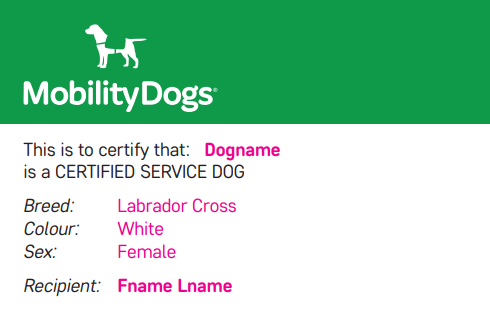
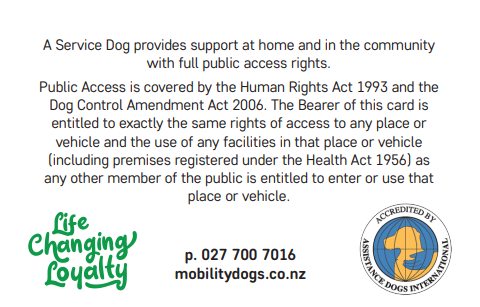
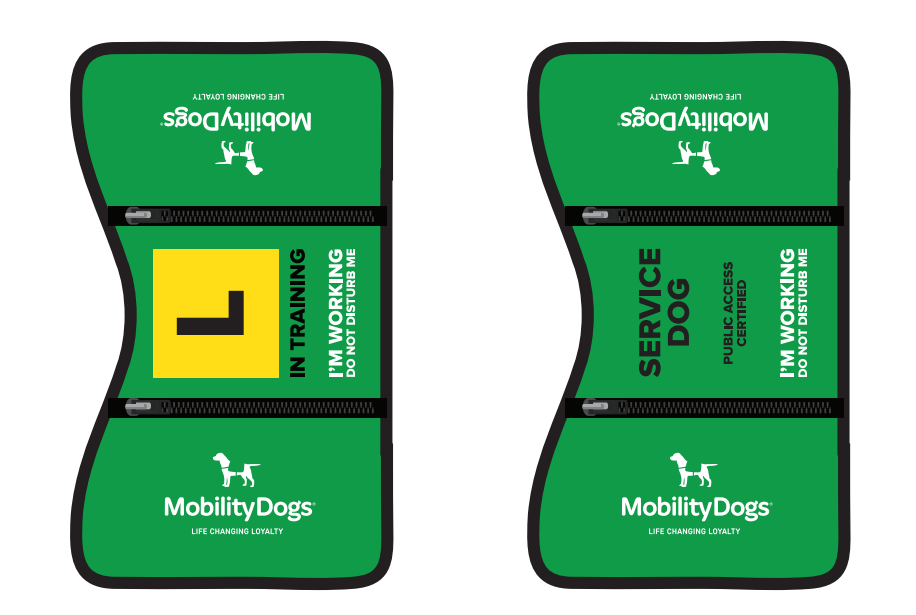 It will be clearly marked and will include:

- A handler’s license including photo identification


- A handler’s license including photo identification
- ID tag on their collar
- An employee’s ID card
What is a Public Access Test?
The purpose of the Public Access Test (PAT) is to ensure that dogs that have public access are stable, well-behaved and unobtrusive to the public.
Mobility Assistance Dogs have been trained to be able to perform identifiable physical tasks or behaviours to assist a person with disability in a way that reduces their need for support.
What is the legal understanding of an Assistance Dog in New Zealand?
The Dog Control Act 1996 Section 2, sets out the legal definition of disability assist dog means a dog that is certified as being a dog that has been trained (or is being trained) to assist a person with a disability.
Section 75 goes on to say:
(1) Any disability assist dog accompanying and assisting a person with a disability, or accompanying a person genuinely engaged in the dog’s training, may enter and remain—
- in any premises registered under regulations made under section 120 of the Health Act 1956; or
- in any public place.
(2) However, the person whom the dog is accompanying must comply with any reasonable conditions imposed by the occupier or person controlling the premises or place in relation to the entry or presence of the dog.
What opportunities do you have for volunteering with dogs and puppies?
We are always looking for Puppy Raisers, Puppy Boarders, and also breeders. Please click here to explore your options.
Why can’t I pat a Mobility Dog?
Touching is a distraction and can prevent Mobility Dogs from tending to their human partners. Be sensitive to the fact that Mobility Dogs are working and may be in the middle of a command or direction. Please always ask the handler before interacting with a Mobility Dog – whether they are in training or working with their handler. Interaction includes talking to or making sounds at the dog as well as touching it.
Do you buy puppies or take donations of puppies for your programme?
We do not have our own breeding programme and usually purchase puppies from Registered Breeders, if we accept a donated puppy it must be from a Registered Breeder. Prior to purchasing or accepting a donation of any puppy, we would need the following information sent to info@mobilitydogs.co.nz:
- Certified Pedigree for the puppy
- Canine Hip and Elbow Dysplasia Evaluation Report for Dame and Sire
- DNA/Genetic Analysis Report (including Exercise Induced Collapse and Progressive Rod Cone Degeneration) for Dame and Sire
We do not condone puppy farming and will not purchase puppies from puppy farms.
Can I adopt or purchase a dog that has been released from your programme?
Due to the success of our programme it is rare that we release dogs. We try to ensure that our dogs move through our three programmes and if we do have to exit a dog, we will always offer them to our puppy raisers first before seeking alternative homes. We do not keep a waiting list of people who wish to apply for a released dog.
What happens when a dog retires from working as a Mobility Dog?
The client and Client Coordinator will usually decide when a dog is ready to retire. At this time we ensure they find a loving ‘forever home’ which can be with the client or the client’s own family or friends’ network. On the rare occasion we will look outside of the clients network to rehome a dog depending on the individual circumstances.
Why does it cost so much to train a Mobility Dog?
It costs in excess of $50,000 to train each Mobility Dog. This includes everything from purchasing a puppy, to food, vaccinations, training, and placement of dog to client. We do not receive government funding and therefore rely on the generosity of individuals, corporate and philanthropic organisations to provide our vital services to the community.
What breeds of dogs do you use for your programmes?
Our dogs are Labradors, Golden Retrievers, and Labrador Golden Retriever crosses, at this time. Our dogs are matched with clients based on the skillset and temperament of a dog in relation to a client’s specific needs.
What training methods do you use to train your dogs?
Training is fun! Our dogs enjoy group classes and one-on-one training while visiting different community environments. Our trainers and our puppy raisers use positive reinforcement methods to elicit and motivate desired behaviours.
What can I do if I see a Mobility Dog being mistreated or behaving in an inappropriate manner?
We can only assist if the dog in question is a Mobility Dog. Our dogs wear a green service jacket with Mobility Dogs and Assistance Dogs International logos clearly displayed on the top and sides. If you would like to report an incident involving one of our dogs, please email the following details to info@mobilitydogs.co.nz
- Your name and phone number
- Location of incident
- Breed of the dog (Labrador, Golden Retriever, Labradoodle, other)
- Colour of the dog (yellow, black, chocolate, other)
- Name of the dog or handler (if known)
If it is not a Mobility Dog, you will need to contact the organisation responsible for accrediting the dog. If it is a case of mistreatment, please contact the SPCA (or equivalent) in your local area.
How can I support Mobility Dogs?
You can support Mobility Dogs by the following ways:
- Sponsor a Puppy
- Create your own fundraising event – this can be anything from having a bake sale to running a marathon and everything in between. Your imagination is your only limitation.
- Become a regular donor
- Leave a Bequest or a gift in your Will
- Sign up for payroll giving
For more information about supporting or getting involved with Mobility Dogs click here.